
Golden: http://codeulate.com/2013/08/how-much-should-global-variables-cost/
Cloud Backup for Linux (and Mac, Windows and Solaris) with Crashplan
Set my parents up with this on Linux a while back. They have nothing but praise for it and have used it to get back files and to migrate to a new machine. Good stuff.
(I have no affiliation with Crashplan, just a genuine recommendation.)
Hacking on (Wikipedia’s) MediaWiki
I worked on an issue with WikiMedia Commons’ UploadWizard this weekend. It was super-easy to get started with the How to become a MediaWiki hacker, the Developer Hub and a little help from #mediawiki on Freenode.
There’s lots of easy bugs to fix!
Firefox Does Not Respect line-height on a Text Input
Which is annoying. You can use height to make it the height you need instead.
Learning Clojure
I completed the first 50 problems at 4clojure.com.
The site helps you learn Clojure in the common way by presenting you with a long set of tasks.
As well as setting the problems it tests your answers live in the browser.
You can follow other users. Once you complete a problem you can see their solutions.
Sometimes that leads you from a solution that looks like this:
fn [coll]
  ((fn dist [prev coll]
     (lazy-seq
      (when-let [[x & xs] (seq coll)]
        (let [more (dist (conj prev x) xs)]
          (if (contains? prev x)
            more
            (cons x more))))))
   #{} coll))
to one that looks like this:
reduce #(if (some #{%2} %) % (conj % %2)) []
Good stuff.
Practical URL Validation
There’s a lot of code out there that deals with URL validation. Basically all of it is concerned with “does this URL meet the RFC spec?” That’s actually not that interesting a question if you are validating user input. You don’t want ‘gopher://whatever/’ or ‘http://10.1.2.3’ as valid URLs in your system if you have asked the user for the address of a web page.
What’s more, because of punycode-powered internationalized URLs most URL validating code will tell you that real URLs that people can use today are invalid (PHP’s parse_url is not even utf8 safe).
Here’s some PHP code that validates URLs in a more practical way. It uses the list of TLDs in static::$validTlds from the IANA list of valid TLDs and assumes the presence of a utf8-safe $this->parseUrl such as Joomla’s version.
    (c) 2013 Thomas David Baker, MIT License

    /**
     * Return true if url is valid, false otherwise.
     *
     * Note that this is not the RFC definiton of a valid URL.  For example we
     * differ from the RFC in only accepting http and https URLs, not accepting
     * single word hosts, and accepting any characters in hostnames (as modern
     * browsers will punycode translate them to ASCII automatically).
     *
     * @param string $url Url to validate.  Must include 'scheme://' to have any
     *                    chance of validating.
     *
     * @return boolean
     */
    public function validUrl($url) {
        $parts = $this->parseUrl($url);

        // We must be able to recognize this as some form of URL.
        if (!$parts) {
            return false;
        }

        // SCHEME.
        // Must be qualified with a scheme.
        if (!isset($parts['scheme']) || !$parts['scheme']) {
            return false;
        }
        // Only http and https are acceptable.  No ftp or similar.
        if (!in_array($parts['scheme'], ['http', 'https'])) {
            return false;
        }

        // CHECK FOR 'EXTRA PARTS'.
        // If a URL has unrecognized bits then it is not valid - for example the
        // 'z' in 'www.google.com:80z'.
        // This check invalidates URLs that use a user - we don't allow those.
        $partsCheck = $parts;
        $partsCheck['scheme'] .= '://';
        if (isset($partsCheck['port'])) {
            $partsCheck['port'] = ':' . $partsCheck['port'];
        }
        if (isset($partsCheck['query'])) {
            $partsCheck['query'] = '?' . $partsCheck['query'];
        }
        if (isset($partsCheck['fragment'])) {
            $partsCheck['fragment'] = '#' . $partsCheck['fragment'];
        }
        if (implode('', $partsCheck) !== $url) {
            return false;
        }

        // HOST.
        if (!isset($parts['host']) || !$parts['host']) {
            return false;
        }
        // Single word hosts are not acceptable.
        if (strpos($parts['host'], '.') === false) {
            return false;
        }
        if (strpos($parts['host'], ' ') !== false) {
            return false;
        }
        if (strpos($parts['host'], '--') !== false) {
            return false;
        }
        if (strpos($parts['host'], '-') === 0) {
            return false;
        }
        // Cope with internationalized domain names.
        $host = idn_to_ascii($parts['host']);

        $hostSegments = explode('.', $host);
        // The IANA lists TLDs in uppercase, so we do too.
        $tld = mb_strtoupper(array_pop($hostSegments));
        if (!$tld) {
            return false;
        }
        if (!in_array(mb_strtoupper($tld), static::$validTlds)) {
            return false;
        }
        $domain = array_pop($hostSegments);
        if (!$domain) {
            return false;
        }

        // PATH.
        if (isset($parts['path']) && substr($parts['path'], 0, 1) !== '/') {
            return false;
        }

        // If you made it this far you're golden.
        return true;
    }
Looking at the list of interesting URLs from http://mathiasbynens.be/demo/url-regex and elsewhere it allows all of the following:
http://foo.com/blah_blah
http://foo.com/blah_blah/
http://foo.com/blah_blah_(wikipedia)
http://foo.com/blah_blah_(wikipedia)_(again)
http://www.example.com/wpstyle/?p=364
https://www.example.com/foo/?bar=baz&inga=42&quux
http://✪df.ws/123
http://➡.ws/䨹
http://⌘.ws
http://⌘.ws/
http://foo.com/blah_(wikipedia)#cite-1
http://foo.com/blah_(wikipedia)_blah#cite-1
http://foo.com/unicode_(✪)_in_parens
http://foo.com/(something)?after=parens
http://☺.damowmow.com/
http://code.google.com/events/#&product=browser
http://j.mp
http://foo.com/?q=Test%20URL-encoded%20stuff
http://مثال.إختبار
http://例子.测试
http://उदाहरण.परीक्षा
http://1337.net
http://a.b-c.de
And disallows all of these:
# Invalid URLs
http://
http://.
http://..
http://../
http://?
http://??
http://??/
http://#
http://##
http://##/
http://foo.bar?q=Spaces should be encoded
//
//a
///a
///
http:///a
foo.com
rdar://1234
h://test
http:// shouldfail.com
:// should fail
http://foo.bar/foo(bar)baz quux
ftps://foo.bar/
http://-error-.invalid/
http://a.b--c.de/
http://-a.b.co
http://0.0.0.0
http://10.1.1.0
http://10.1.1.255
http://224.1.1.1
http://1.1.1.1.1
http://123.123.123
http://3628126748
http://.www.foo.bar/
http://www.foo.bar./
http://.www.foo.bar./
http://10.1.1.1
http://10.1.1.254
# The following URLs are valid by the letter of the law but we don't want to allow them.
http://userid:password@example.com:8080
http://userid:password@example.com:8080/
http://userid@example.com
http://userid@example.com/
http://userid@example.com:8080
http://userid@example.com:8080/
http://userid:password@example.com
http://userid:password@example.com/
http://-.~_!$&\'()*+,;=:%40:80%2f::::::@example.com
http://142.42.1.1/
http://142.42.1.1:8080/
http://223.255.255.254
ftp://foo.bar/baz
parse_url Is Not UTF-8 Safe
Handily the good folks at Joomla have written a UTF-8 safe version:
        /**
	 * Does a UTF-8 safe version of PHP parse_url function
	 *
	 * @param   string  $url  URL to parse
	 *
	 * @return  mixed  Associative array or false if badly formed URL.
	 *
	 * @see     http://us3.php.net/manual/en/function.parse-url.php
	 * @since   11.1
	 */
	public static function parse_url($url)
	{
		$result = false;

		// Build arrays of values we need to decode before parsing
		$entities = array('%21', '%2A', '%27', '%28', '%29', '%3B', '%3A', '%40', '%26', '%3D', '%24', '%2C', '%2F', '%3F', '%23', '%5B', '%5D');
		$replacements = array('!', '*', "'", "(", ")", ";", ":", "@", "&", "=", "$", ",", "/", "?", "#", "[", "]");

		// Create encoded URL with special URL characters decoded so it can be parsed
		// All other characters will be encoded
		$encodedURL = str_replace($entities, $replacements, urlencode($url));

		// Parse the encoded URL
		$encodedParts = parse_url($encodedURL);

		// Now, decode each value of the resulting array
		if ($encodedParts)
		{
			foreach ($encodedParts as $key => $value)
			{
				$result[$key] = urldecode(str_replace($replacements, $entities, $value));
			}
		}
		return $result;
	}
Although non-ASCII characters are not legal in URLs if you want to parse possibly wonky data or internationalized (例子.测试) and other non-ASCII URLs (✪df.ws) that translate to ASCII via Punycode then this is very handy.
Keeping Control of Your Z-Indexes With LESS
A colleague of mine recently took advantage of LESS in a simple but very useful way.
/* Relatively positioned dialog overlay. */
@z-index-dlg-rel-overlay: -2;

/* Position of box shadow to dialog. */
@z-index-dlg-box-shadow: -1;

/* Close button on dialog boxes. */
@z-index-dlg-close: 1;

/* Overlay on the dialog itself making it "disabled." */
@z-index-dlg-disabled: 2;

/* Modal dialog position. */
@z-index-dialog: 100;

/* Main window overlay for dialog. */
@z-index-dlg-overlay: 1000;

/* Position of main (topmost) dialog. */
@z-index-dlg-main: 10000;

/* Main content loading spinner. */
@z-index-cnt-loading: 1;

/* Position of orangle flag triangle on auth pages. */
@z-index-ath-triangle: 1;

/* Absolutely positioned delete (X) button. */
@z-index-btn-delete: 10;

/* Position of downward triangle on content title. */
@z-index-tri-title: 5;

/* Position drawers below dialogs. */
@z-index-drawer: @z-index-dialog - 1;

/* Position of floating navbar. */
@z-index-navbar: 1000;

/* Position of popup about menu. */
@z-index-nav-about: 100;

/* Position of search box on nav menu. */
@z-index-nav-search: 1;
He gathered every z-index on the site into a single LESS file as a variable. Now whenever you add something with a z-index you can think about “yes, I want it on top but not over the floating nav or a modal dialog” rather than just jamming 999999 and hoping for the best. Neat!
Vertically Centering Text in a Fixed-Size Element With No Overflow
Most of the blog posts/tutorials on the web that show you how to center text vertically using either line-height (only works for a single line of text) or using display: table-cell which allows the text to exceed a fixed size (table cells are allowed to get taller than their height if the text is long). Here’s a version that clips the overflow by surrounding the display: table-cell element in a containing div.
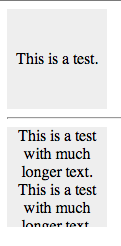
<style>
    /* Wrapper exists to prevent long text exceeding the bounding box. */
    .wrapper {
        /* height and width here act as a maximum for when the text is very long. */
        height: 100px;
        width: 100px;
        overflow: hidden;
        background: #eee; /* just so we can see what's going on in the demo */
    }
    /* Cell does the work of allowing us to vertical-align: middle. */
    .cell {
        /* height and width here act as a minimum for when the text is not long. */
        height: 100px; /* subtract any padding on wrapper from height and width here */
        width: 100px;
        display: table-cell;
        text-align: center;
        vertical-align: middle;
    }
</style>

<div class="wrapper">
        <div class="cell">
            This is a test.
        </div>
</div>
<hr>
<div class="wrapper">
        <div class="cell">
            This is a test with much longer text.  This is a test with much longer text.  This is a test with much longer text.  This is a test with much longer text.  This is a test with much longer text.
    </div>
</div>
How to Get Reasonably Priced Pay As You Go Data (and Calls and Texts) on an Unlocked iPhone in the US
Here is a system that has worked for me in the USA on an iPhone 4 and an iPhone 5 in July 2012 and February 2013. Both phones were not locked to any particular carrier but they were not jailbroken.
- Visit an AT&T store or otherwise get a GoPhone SIM that fits your phone (micro sim or nano sim). Choose whatever rate plan suits your needs. I’m partial to the $25 for 30 days unlimited texts and 250 minutes. Note that the salesperson will almost certainly tell you that you won’t be able to get data on this plan – they are wrong just say ok!
- Connect your phone to wifi somewhere (Starbucks if all else fails!) Visit unlockit.co.nz through your phone’s browser. This site is going to make twiddling your internet settings a lot easier – it doesn’t jailbreak or carrier-unlock your phone it just changes internet access settings in a simple way. Choose Create APN, “USA” and “GoPhone”. Press “Install” to install the settings.
- Set up a PIN for your account by getting it texted to the phone. You can choose “Forgot Password” from the GoPhone login page to set it up.
- Sign in to your GoPhone account and add a data package (200MB for 30 days for $15 for light usage or 1GB for 30 days for $25 for heavier usage). You’ll need a credit/debit card to do this entirely online or you can use a refill card you bought in a store.
And that’s it. You may need to remove the APN settings that you installed when/if you leave the US.